

Faith . . . What does it mean?

Abraham on his journey (Image MS Designer AI)

In Genesis 12, God calls Abram (later Abraham) to leave his native country and all his relatives to “go to the land that I will show you” (v 1). This “calling” has been likened to Jesus saying to those who would become his disciples, “Leave all that you have and follow me.”
As time passed, God expounded on the promise to Abram of the blessing that he would receive and that he and his descendants would be to all the nations (12:2; 15:1-18; 17:1-21).

In the midst of this, Abram reached a point where he was questioning how all of this would take place, since he had no son. Yahweh assured Abram, “Fear not, Abram, I am your shield; your reward shall be very great” and reiterated the promise (15:1-5). Genesis tells us that even before the promise was realized, Abram “believed the LORD, and [Yahweh] counted it to him as righteousness” (6). Abram’s faith was such that he is considered the father of the faithful. Paul uses him as an example in Romans and in Galatians, as did the writer of Hebrews, as well as James in his epistle.

The Bible says to “believe in the Lord Jesus, and you will be saved” (Acts 16:31) and there is a tendency by some to think that as long as I believe in God and am a good person, that is enough. However, as we put together the message of the entire Scripture we see that faith is about a willingness to follow obediently. Justification is a one time, almost transactional, occurrence, but to follow the example of Abram and the disciples, a living faith has action. A living faith based on the examples we have in God’s Word (1 Cor 10:6, 11) seems to be a willingness to follow obediently, based on a trust that God will lead faithfully. It won’t be perfect, and oftentimes God will do / allow things that we do not understand, but that is where faith comes in.

Faith is a journey. Sometimes it is challenging. But, if you are willing to walk it, you will find that Yahweh has a tendency to blow your mind!

Get Out of the Way

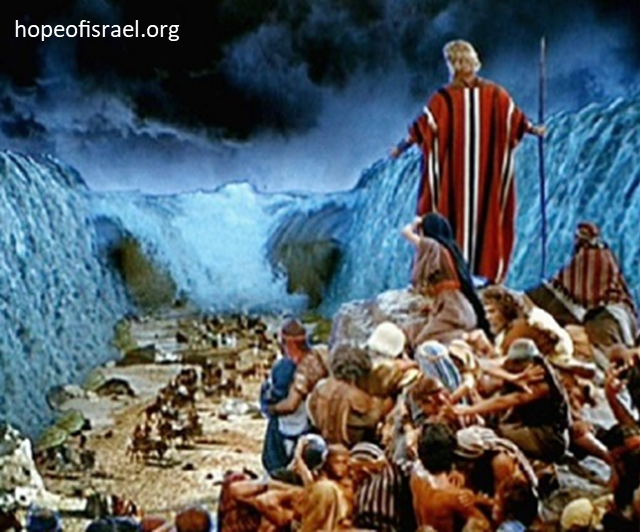
One of the things that has been so powerful for me is God’s promise to Israel that He will fight for them. As I am writing in my dissertation from the book of Exodus right now, I am once again reminded of this. Yahweh had one last encounter set up with Pharaoh and His promise to His people? “Fear not, stand firm, and see the salvation of the LORD, which he will work for you today . . . The LORD will fight for you, and you have only to be silent” (14:13-14). He makes a similar statement again in Deuteronomy: “You shall not fear them, for it is the LORD your God who fights for you” (3:22).

God repeatedly told Israel that as they walked in relationship with Him, not to fear, for He would fight for them. Sometimes that meant that they had to take the step and fight in the battle, but the outcome was fully in Yahweh’s hands. However, there were also times–such as the Red Sea–where God completely acts on Israel’s behalf and they need “only to be silent.”
As I was pondering this today, I had the thought, God was taking care of Israel’s enemy and all Israel had to do was get out of the way! Israel had to respond in obedience and take the step onto that ground now dry and providing a path before them. If they would have stayed there on the shore or tried to fight the Egyptians themselves, they would not have had a chance!

Can you see the timeless application? As we are Jesus followers, actively engaged in relationship with Him, He will also fight for us. Sometimes we participate in the battle and might get a bit messed up, but the outcome is in His control. Sometimes He will handle it completely and He just needs us to be still and pay attention to where He wants us to move to get out of the way!

Don’t be one of the crowd

I was recently reading Luke 4:14-30. It was interesting to me an emphasis that seemed to be made in the text. In the prior section, Jesus had just been led into the wilderness by the Spirit to be tempted by the devil (4:1). Jesus, of course, had not fallen for satan’s temptations, but put him in his place with Scripture. Jesus had “returned to Galilee in the power of the Spirit” (14).

Next is the beginning of what I noted – News of Jesus had spread throughout the region and he was “being praised by everyone” (15 CSB*) or the ESV* says, “being glorified by all.” We enter the scene where Jesus was called upon to read at synagogue and the passage was from Isaiah regarding the one anointed to proclaim good news to the poor and liberty to the captives and those who are oppressed; to recover the sight of the blind. After Jesus sat down, he then had the audacity to state, “Today this Scripture has been fulfilled in your hearing” (21). (I’m pretty sure I heard a gasp.) [About being blind . . . ]

Verse 22 reiterates the favor of the people – “All spoke well of him and marveled at the gracious words that were coming from his mouth” and yet something was stirring, because, wasn’t this Joseph’s son? Then, seeing their response, Jesus stirred the pot even more. He proceeds to tell them that a prophet is not welcome in their hometown, but that God had already established a precedent in taking his kingdom where it would be accepted, to the gentiles, as illustrated by Elijah and the widow Sidon and Elisha and Naaman the Syrian.

What was the people’s response now? “all the people in the synagogue were filled with rage as they heard these things” (28). How dare this presumptuous local son!

As I pondered this, I thought of two things –
1) for those in any sort of leadership role, beware of the favor of humanity, because it is fickle and can turn as soon as something pushes the right button
2) for all of us when not in a leadership role, we need to be careful of our reactions – particularly in our present culture where “all the people” feel they need to express their opinion without taking a step back to analyze the situation.
Don’t “shoot the messenger.” Does what you are hearing line up with the character of God and the principles and values of his kingdom that are found in the Bible? Do your responses fall into line with that same standard?

*CSB: Christian Standard Bible
ESV: English Standard Version

“Make Room” . . . for Everything Else

There’s a popular phrase right now . . . I heard it again this morning, “God, I will make room for you;” “let’s make room for God.” Every time I hear it, it disturbs me.
Now, let me first admit that this may just be a matter of semantics, but if I’m interpreting it this way, at least some others are as well. For those of us in positions of leadership or influence, it may convey the wrong message.
What was Moses commanded to tell God’s chosen people? “Listen, Israel: The LORD our God, the LORD is one. Love the LORD your God with ALL your heart, with ALL your soul, and with ALL your strength. These words that I am giving you today are to be in your heart.” (Deut 6:4-6 CSB) Over and over again, the thing Israel got into trouble with God about was putting other gods before Him. What is a false god? Anything that controls our time, resources and attention.
Jesus reiterated this concept with the early Church when challenged by the religious leaders: “He said to him, “Love the Lord your God with ALL your heart, with ALL your soul, and with ALL your mind. This is the greatest and most important command.” (Matt 22:37-38 CSB)
Now this phrase . . . when I think of making room for something, I think of my book shelf and getting a new book and I need to figure out a way to rearrange things to make room for the new book -but it’s just enough space to squeeze it in there. Or maybe my schedule, when I want to “make room” for getting Theo into the vet for his vaccine – I may move some things around to make a space for the appointment. That’s fine for books, other physical things or our calendars, but that is not the expectation of our Father God.
Our relationship with God is like the priceless piece of art that we’ve been searching for, for a decade and finally find it. We bring it home and, mindless of what may be there, push everything off the table and give it that place of honor right there as the center of focus!
Of course, the metaphor breaks down after that, because God is not an inanimate piece of art, but rather, a transcendent Being who desires intimate, personal engagement with us daily and fully, our hope and life, His kingdom our mission and reason for living, and as we respond in this fashion, He will turn our world upside down in ways we never imagined!
He wants all of us and then as we give ourselves up to Him, He will help us “make room” for other things in a life that will have more purpose and meaning than we’ve ever known.

Get Your Goat On

You will seek me and find me, when you seek me with all your heart.

Jeremiah 29:13 ESV

A few weeks ago I was driving our motor home in an area new to us and passed by a small pasture area. I am an animal lover, so the presence of pretty much any kind of four-legged furry friend captures my attention. This particular image was quick as I saw just two goats and two cows at a central feeding area. What caught my eye though was one of the goats – I love goats; particularly spunky little pygmies. These however were larger white goats with horns and the one caught my eye because he was full body into the feed area, with his head burrowed so deep that you could not even see his face. While the other goat and the cows pulled out a little “hay” and munched it, this guy was pressing in for the better stuff. Maybe it was a little sweeter or had a little more moisture than the easily accessible feed, but it was worth getting stabbed in the face, eyes tightly shut, straw in the nose, to dig in.

Thank you Hannah Miller for the fursies!

In that brief moment, I simply thought, “Abba, that is how I want to be in Your Word and in relationship with you.”

In restoring Israel from exile, we know the very popular verse, “For I know the plans I have for you, declares the LORD, plans for welfare and not for evil, to give you a future and a hope” (Jeremiah 29:11). That passage continues though with “Then you will call upon me and come and pray to me, and I will hear you. You will seek me and find me, when you seek me with all your heart. I will be found by you, declares the LORD, and I will restore you . . .” (11-14a; emphasis added). This verse 13 is a life verse for me that constantly challenges me to seek God with all my heart, setting aside anything that would be an idol that robs my time and focus from Him and all that He wants to be in my life.

Take this little image of a tenacious, horned white goat who wanted more and was willing to stick his face in the poky straw in order to get it!

Feel Your Way Toward Him

    I read an interesting passage in my devotional time this morning. Acts 17:27-28 (ESV) – “that they should seek God, and perhaps feel their way toward Him and find Him. Yet He is not far from each one of us, for ‘in Him we live and move and have our being,’ as even some of your own poets have said, ‘For we also are His descendants.'”* Two things captured my attention . . .
    The first is a thought that fills my heart and leaves me in awe and that is the fact that God calls us “His descendants.” Not only is humanity created in His image, we are His descendants. For those who have chosen to engage with Him, we call Him Father and He brings a sense of belonging that we can find nowhere else.
     As wonderful and awe-inspiring as that is, that is a potential topic for another day.
I want to focus on a second phrase: “that they should seek God, and perhaps feel their way toward Him and find Him. Yet He is not far from each one of us.”

The context of the passage is Paul speaking to the “men of Athens” who were “very religious” even to have an altar “to an ‘Unknown God.'”
My initial thought was, “feel their way toward Him”??? I read it originally in the NASB, which states, “feel around for Him.” Why, God, would the author say that we need to feel our way to find You?
Consider this scenario – you are blind as the proverbial bat and the dog jumps up in your face and sends your glasses flying. No one else is at home, so what are you going to do (after you holler at the dog)? You are going to feel around to find your glasses because you are unable to see without them.

     We have to “feel our way toward” the Father because without Him, we are spiritually blind. It is interesting how much we see conversations about sight in the New Testament. There are many conditions of which people could have been healed by Jesus, and yet frequently the Gospels share stories of Jesus restoring people’s sight. That seems significant.
     The word “blind” occurs in some form 50 times in the New Testament in the ESV^. Of those, 44 times are in the Gospels, which tell the story of Jesus. We see the word 14 times in Matthew where it culminates with chapter 23 and Jesus addressing the religious leaders – “blind guides,” “blind fools,” “blind men,” “blind Pharisee”! Jesus challenges His followers to follow the things that they teach, but not the things that they did because they did not practice what they were preaching. Additionally, they missed the point, as they were more focused on the works of the Law than they were on its intent – love the people in order to draw them to the One and Only God – and most of them completely missed the Messiah.
     But note this also about the phrase from Acts. We need to look for God; however,  He is not far from each one of us. We have to take the step toward Him, but guess what, Dear Friend, He wants to be found! It is not the childhood game of hide and seek where you looked for the best hiding place in the most remote location. No, our God is close – He wants only for us to respond to the nudging of our spirit, reach out our arms and “feel for Him,” and He responds by making Himself known in the way that He knows will best reach us.
     One of my favorite verses: “You will seek me and find me, when you seek me with all your heart. I will be found by you, declares the LORD” (Jer 29:13-14a ESV). Even if you are a Christ-follower, continue to “feel for Him,” to that next step of growth, change or challenge that He wants you to take.

*From Aratus’s poem “Phainomena”
^ESV: English Standard Version

“Disposition of Compassion”

  The sermon series at our church right now is focused on character traits of God as seen in Exodus 34. Today’s topic was “compassion,” as declared by the LORD of Himself in verse 6 – “The LORD, the LORD God, compassionate and merciful, . . .” There is so much to this verse, this passage, but I will stick to the topic at hand.

     In the message this morning, Pastor Trevor used the expression, “disposition of compassion.” I love this! For those who know me, you know I am “a dog person.” When talking about dogs, sometimes it is asked, what is their disposition? What is their personality like? For people, Oxford Dictionary refers to this as “inherent qualities of mind and character.” This brings up another word, “inherent.” Hmmm . . . “Existing in something as a permanent, essential, or characteristic attribute” (also Oxford). Pastor Trevor mentioned how compassion can seem so far from our present culture. Unfortunately, this often includes those professing the name of Christ as well. Let’s face it, in ourselves, it is hard to want to be compassionate when it feels like everyone around us is just looking out for their own best interest and fighting for their own truth to be heard.

    Recent months have seen many people in the news or on social media who refer to themselves or are known as “Christians,” and yet they seem to be missing the point. John says, “By this all people will know that you are My disciples: if you have love for one another” (13:35). The Early Church grew like wildfire in the midst of social ridicule and physical persecution because they were “distinct” – different, set apart. They had something to offer that was not present in their culture.

     Please know, this is not a guilt trip – I am the first one to admit that I am challenged when it comes to loving people – I am so grateful that “He is mindful that we are nothing but dust” (Ps 103:14b), but in that, we can present ourselves to the world in great humility, with a “disposition of compassion” that reaches out to those who are behaving as is expected because they do not know the Savior – but we do! We can choose to be different both in our compassion – because we have been forgiven by One who is perfect – and in our choice to live lives that are distinct, “holy,” set apart.

And by the way, the entirety of the verse and the one preceding God’s mercy on our “dust-ness”? “He has not dealt with us according to our sins, Nor rewarded us according to our guilty deeds. For as high as the heavens are above the earth, So great is His mercy toward those who fear Him. As far as the east is from the west, So far has He removed our wrongdoings from us. Just as a father has compassion on his children, So the LORD has compassion on those who fear Him. For He Himself knows our form; He is mindful that we are nothing but dust” (Psalm 103:10-14 NASB).

Boasting in Weakness

But he said to me, “My grace is sufficient for you, for my power is made perfect in weakness.” Therefore I will boast all the more gladly of my weaknesses, so that the power of Christ may rest upon me.

2 Corinthians 12:9 ESV
The squirrel standoff when I kicked him off the bird feeder!

Last week was vacation from work for us. I love vacation; most of us do. We spent the first portion of the time in our motor home at our camping lot and were able to enjoy several trips to Kayak Point – a spot on the Puget Sound just a few minutes away.

When our week geared down and I refocused on assignments due and facing working on Monday, I found myself feeling very overwhelmed. This class is particularly heavy and I often feel like my brain is Teflon – everything just slips off. In addition, while I like my new job, it is work enough for two people during a normal week and I will likely return to about 700 email, literally. Is this blog a whine about my life? No, there’s a purpose . . . hang with me . . .

In the midst of this, I read the verse about weakness and God’s grace and power in 1 Corinthians 12. I do not like weakness; I never have. Having said that, I currently find myself in this pressure place where everything is so much that I cannot even hope to achieve it in myself and I have reached a place of utter dependence on God.

“My grace is sufficient for you, for my power is made perfect in weakness.”

“But God, would it not be better if I was competent and confident and
able to function well with the gifts that you have given me?”

“My grace is sufficient for you, for my power is made perfect in weakness.”

We live in some very challenging times. People feel the need to express their opinions and are intolerant of others having different views. Many things that were “normal” about daily life have changed. I know I have had in-person interactions with only a few people in the last five months. All of this adds a level of stress to our lives. I find that the only way to cope with it is to daily give it all up to Jesus. Often, I am on my knees praying and literally just lift my arms up to Him, symbolically offering all that is weighing me down.

With additional burdens and stressors, it is easy just to feel wiped out and anxious – weak. I feel flat as a pancake sometimes. God’s Word advises that if we confess our weakness, His power is made perfect and rests upon us! It seems counter intuitive, but that is what Paul tells the Corinthians, he will be even more “out there” about his area(s) of weakness so that the power of Christ may rest upon him.

While it may seem unusual, this verse offered me hope this week and I trust it will do the same for someone else. I am weak, particularly compared to my all-powerful Father. But when I place my pancake-flat life, my concerns and worries and stresses, all my inabilities, in His hands – giving up my ability to do anything, then His power can be manifest.

“My grace is sufficient for you, for my power is made perfect in weakness. Therefore I will boast all the more gladly of my weaknesses, so that the power of Christ may rest upon me.”

Thank you, Father, that you cover us in our weakness!

Peace is a Heart Guard

Rejoice in the Lord always. I will say it again: Rejoice! Let your gentleness be evident to all. The Lord is near. Do not be anxious about anything, but in every situation, by prayer and petition, with thanksgiving, present your requests to God. And the peace of God, which transcends all understanding, will guard your hearts and your minds in Christ Jesus.
Finally, whatever is true, whatever is noble, whatever is right, whatever is pure, whatever is lovely, whatever is admirable – if anything is excellent or praiseworthy – think about such things. Whatever you have learned or received or heard from me, or seen in me – put it into practice. And the God of peace will be with you.

Philippians 4:4-9

These verses have popped up in my life several times over the last few weeks. When that happens, I pay attention!

I know just a little bit about anxiety from personal experience. Two months ago I moved out of a job where I was daily experiencing clinical levels of anxiety. I finally went to the doctor to have my heart checked, because I was concerned that the heart pounding I was experiencing all throughout the day was a physical problem. Nope, anxiety.
I was moved against my will into a job that I literally could not do. The meetings were a foreign language to me. I plastered verses all over my home office reassuring me of God being with me and that focus was the only thing that got me through three months of off-the-chart anxiety. I did not do it well.
Thankfully, I was able to move to a new situation and that high level of persistent anxiety went away. I know that sort of relief does not happen for everyone and chronic, long-term anxiety is a completely different situation but God offers hope and help.

Paul is writing to the Philippian church from prison (1:13-14), yet from “his chains” the book has an overriding message of rejoicing in Jesus Christ. In chapter 4, Paul challenges the believers in Philippi to “not be anxious about anything.”

Paul was writing to the church at Philippi, but the faithfulness of God remains the same across all generations. Paul assures that if, as a Christ-follower, you choose to engage with God in every situation and pray and ask of Him with thanksgiving, . . .

  • the peace of God which transcends all understanding . . .
    His peace is beyond all that we can comprehend. It is also beyond us because our minds cannot grasp that if we have given our lives to Him, He holds us safely in His hands. While He may or may not answer what we have requested, we can trust Him with ourselves, knowing that He is a good God who – even in the most difficult of times – will walk with us every step of the way. (Heb 13:5)
  • the peace of God will guard your hearts and your minds in Christ Jesus
    “In the present context God’s peace will be his “garrison” (a striking military metaphor) around our hearts when anxiety threatens. It will also guard our “thoughts”—those very thoughts that lead to fear and distress and that keep one from trusting prayer . . . such protection is in (or “by”) Christ Jesus. It is the Philippians’ relationship to God through Christ, in whom they trust and in whom they rejoice, that is the key to all of these imperatives and this affirming indicative.”*

But wait, there is more! Not only does Paul tell us what God will do, he gives us a tool for working along with God toward knowing His peace.
The human mind is a powerful thing – amazing to me at times, but that is for another day – and our thoughts have a tremendous impact on our lives. PhD Jeffrey Nevid states, “emotions follow thoughts[;] without  thoughts as drivers, emotions are mere shadow puppets on the wall.” God designed our minds, so He knows this better than anyone and tells us through Paul -focus your mind on these things: whatever is true, noble, right, pure, lovely, admirable . . . things excellent and praiseworthy. The things that we learn from Paul (God’s Word), put into practice and “the God of peace will be with you.”

God has said, “never will I leave you; never will I forsake you.” So we say with confidence, “The Lord is my helper; I will not be afraid. What can mere mortals do to me?” (Heb 13:5b-6)

*Gordon D. Fee, Philippians, vol. 11, The IVP New Testament Commentary Series (Westmont, IL: IVP Academic, 1999), 176–177.

Heart of a Hummingbird

The following was written as part of a devotional “program” we are doing for women’s ministry at our church – Mill Creek Foursquare. I am happy to be able to participate as a contributor!

Fort Flagler April 2019

I have a few hummingbirds who live in the cedar tree in my back yard. Since the loss of my dogs, they bring great joy to my life as they buzz around and eat from my feeders. Occasionally, they will buzz my head or hover within four or five feet of me, just looking at me for a few seconds seemingly to see what I am up to. I read once that they average about the weight of a nickel! I was surprised the first time I saw one sit on the end of a small zip tie and it did not bend. They are so tiny!

Jesus talked a bit about some little birds in Luke 10:29-31. “Are not two sparrows sold for a penny? And not one of them will fall to the ground apart from your Father. But even the hairs of your head are all numbered. Fear not, therefore; you are of more value than many sparrows.”

I think about these little birds and how tiny they are in comparison to the world around them. When we are at the beach, there are also eagles and my little hummingbirds are about the size of one of their “toes”! If they had such thought processes, how overwhelming the world would seem to them. But they do not. They just live their little lives focused on the next thing and doing what it is they do.

Jesus returned to the sparrows again in Luke 12:6-7, and basically repeated what He said the first time. Whenever something is repeated in the Bible, we can be sure that God is trying to make a point. With the birds, He is telling us not to fear but to have faith, trusting Him in circumstances that we cannot control. In another point in these passages, Jesus asks the people if they can add “a single hour to [their] life span” by being anxious (12:25). God loves us passionately and desires for us to rest in Him.

When we focus on circumstances and surroundings, our world can seem overwhelming on a “normal” day. This virus has turned things upside-down at the very least for most of us. Some are being impacted financially and others emotionally in small or gigantic ways on a daily basis. Our Pastor prayed at the beginning of this stay-home order, “God, You are still God and You are not surprised by any of this.” That is so very true and is a statement that I have repeated often as this week has brought new realities for us in the frame of decreased hours/pay but continuing to work an “essential” job with the public.

Rest assured, God will bring something good out of this nightmare called COVID-19 as only He can. In the meantime, do not think that He has forgotten you or does not see you. God is not subject to time or space and He will bring peace to your heart and mind as you choose to engage with Him.

Three questions for reflection / journaling

  1. Jesus, where have I made my circumstances bigger than You?
  2. How can I help myself to be mindful every day that You are with me and for me?
  3. Where have I seen/felt God’s presence in my life in the midst of this time of uncertainty?

Abba-God, I thank You that You are God, You are still in control and none of this is a surprise to You. I choose to remember that You see me and know each circumstance of my life and I choose day by day and hour by hour to leave my life in Your more-than-capable hands. Help me, in each new day to continue to place my trust in You, to focus on You. In the name of Your Son Jesus, amen.

(Listen to Pastor Chris’s message on Peace in the Pandemic: https://www.mc4s.org/podcast )